Visible Isn’t the Same as Understood.
A diagnostic lens for the seven domains of organizational stress behind what your engagement scores and operating metrics can’t explain.
The same themes come back in exit interviews quarter after quarter and annual surveys year after year. The same handoffs break, the same deadlines slip, and the same few people cover the gaps. Initiatives launch, participation spikes briefly, and six months later the same strain is back: redistributed, renamed, still there.
The question most organizations haven’t asked yet: why does the pattern keep repeating when the investment keeps going in?
The answer is usually a diagnostic one. Interventions are aimed at the right level of visibility, not the right level of origin.
The Investment Is Going In. But Where’s the Impact?
of organizations use surveys as their primary tool for measuring stress and mental health.
of those organizations are effective at helping employees manage it.
of employees are still considering leaving their jobs due to persistent stress, despite coping strategies being in place.
That gap between measurement and impact, between coping and resolution, is a diagnostic problem. Organizations are intervening. The stress persists. The intervention is aimed somewhere other than where the stress is being generated.
HR.com, State of Employee Mental Health & Stress in the Workplace, 2025.
Insightful, 2025 Workplace Stress Report.
You can’t measure what you don’t know.
You can’t fix what you don’t measure.
You can’t change what you don’t fix.
Employee stress is what people experience: exhaustion, overwhelm, disengagement, the silence in meetings where people used to speak up.
Organizational stress is what exists in the conditions around them: how work gets designed, how decisions get communicated, how change gets managed, how expectations get set without corresponding resources.
These two dimensions don’t operate independently. Organizational conditions shape how people experience work. And how people navigate, respond to, and push back against those conditions shapes the organization in return. Stress moves in both directions, and so does resilience.
Most diagnostics stop at the first dimension. The individual gets the coaching, the resilience training, the wellness app. The conditions generating the strain stay intact.
Think of it this way. If you’re hearing off-key music from an orchestra, your first instinct might be to send the musicians for individual coaching. And that might help, briefly. But what happens when something still sounds off? Do you keep coaching? Or do you start to troubleshoot: check the instruments, confirm everyone is playing from the same sheet of music, verify they’re performing at the right register? Most organizations are running a lot of musician coaching. Few are examining the calibration.
The Stress Model examines the calibration. Across both dimensions, simultaneously.
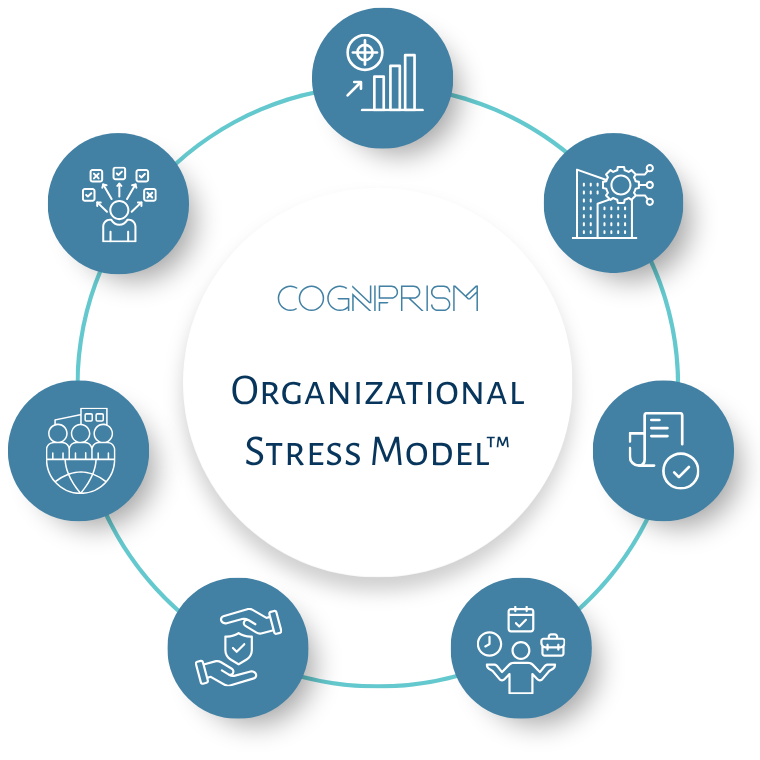
The patterns you’re tracking have origins. The Stress Model maps where they live.
Select any domain to see what’s generating it and what it looks like when it’s working.
You might be seeing this if teams are executing against competing priorities with no clear way to resolve the conflict, or decisions are being made at the top but reaching teams without the clarity needed to drive aligned action.
When direction shifts faster than people can absorb it, or decisions arrive without context, the response is predictable: teams hedge, work around ambiguity, or default to what felt safe last quarter. Leaders read that behavior as resistance, which tightens communication further. When direction is clear and decisions arrive with context, that cycle reverses.
You might be seeing this if bottlenecks keep reappearing in the same places despite process changes, or competent people are spending disproportionate time navigating the organization rather than doing the work itself.
When organizational design doesn’t match how work flows, people build workarounds. Those workarounds become invisible infrastructure: essential, unacknowledged, and fragile. When structure supports the work, the effort people were spending on workarounds goes back into the work.
You might be seeing this if performance is inconsistent across teams doing similar work, or accountability feels unevenly applied and what “good” looks like means different things in different parts of the organization.
When expectations are unclear or inconsistently applied, people can’t perform confidently against a standard they can’t see or trust. Leaders tighten expectations in response to inconsistent output, which compounds the stress rather than resolving it. When standards are clear, achievable, and consistently applied, that cycle breaks.
You might be seeing this if change initiatives are launching but not sticking, or teams are reverting to previous patterns faster than new ones can be established.
When change arrives faster than it can be absorbed, people revert because the new way hasn’t been made navigable yet, and leaders read that as resistance. When that pattern repeats across multiple initiatives, the organization trains its people to wait it out rather than invest in what’s next. When transitions are supported rather than just announced, that dynamic shifts.
You might be seeing this if accountability is in place but results aren’t following, or the gap between what’s being asked and what’s resourced keeps widening.
When people are held accountable for outcomes they don’t have the authority, tools, or resources to reliably produce, they subsidize the gap personally. That subsidy stays invisible until it turns into underperformance or departure, at which point the structural cause has already been obscured by the human symptom. When accountability is matched with the resources and authority to deliver, that gap closes.
You might be seeing this if the candid conversation you need from your team is being replaced by agreement in the room and resistance outside of it, or decisions are gaining consensus but not traction.
When communication norms or past responses to dissent have signaled that honesty carries risk, people adapt: they perform alignment while managing around it. That gap between what’s said in the room and what’s acted on outside of it compounds over time, and the organization starts making decisions based on what people are willing to say rather than what’s true. When candor is structurally safe, decision quality improves.
You might be seeing this if output inconsistency is appearing in people whose capability isn’t in question, or high performers are coasting, disengaging, or leaving without an obvious trigger.
When organizational expectations and individual reality are out of sync, the misalignment produces patterns most organizations aren’t equipped to diagnose: output inconsistency in capable people, disengagement without an obvious trigger, capacity that fluctuates in ways that don’t map cleanly to workload. What someone brings to the work and what the work demands of them shape each other continuously. When that intersection gets examined rather than assumed, the patterns start making sense.
Where Organizational Stress Shapes People. And Back.
You probably already have a way of thinking about the individual side of this. Burnout frameworks. Resilience models. Capacity assessments. Each is useful. Each covers part of the picture.
Organizational patterns reach a person through what’s already in motion: how someone is wired, what they’re navigating outside of work, how much capacity they have on any given day. And what that person brings into the organization (their energy, their patterns, their responses) feeds back into it.
That’s what the 7C Stress-Resilience Model maps.
A dedicated diagnostic lens for the individual side of the same interaction.
The Model Tells You Where to Look. The Assessment Tells You What’s There.
The Stress Model is a diagnostic lens. The CogniPrism Organizational Stress Test™ is how that lens gets applied to your specific organization, your people, your systems.
Where the model maps where stress tends to concentrate, the assessment pinpoints where it’s concentrated in yours: which domains are under strain, how patterns are compounding across them, and where the work matters most given your specific context.
Which program might work this time stops being a guess. The data decides what gets built.
Where Is Stress Concentrated in Your Organization?
The patterns are there. The COST™ is how you find out exactly where, and what’s generating them.
Find the SourcePrefer to start on your own?
Start with your own experience first. Take the Hidden Weight Quiz
Start with the numbers. Estimate the Impact