
What You Do Next Depends on What You Can See.

The quality of any solution depends on the quality of the understanding behind it. So every engagement starts by mapping where strain builds across your people and your systems, and how each keeps feeding the other. Then we decide where the work belongs.
Find the SourceWhat the Work Actually Feels Like
Here’s what to expect once the work begins:
Your strengths count as much as your strain.
The diagnostic reads where strain is concentrated and where resilience already exists: the patterns your people and systems keep running well, and the ones they keep working around. Both shape the design, because the strongest changes build from what’s already working.
You shape the findings as they come in.
With the CogniPrism Organizational Stress Test™ (COST™), you’re inside the work as it happens: shaping how findings get interpreted, which questions get asked next, and what the data means in your context. You come out with an understanding your leaders built together and can act on.
The capability stays with your team.
By the end of the engagement, your team has language for what you’ve been observing, a diagnostic lens you can apply on your own, and frameworks you can run without us in the room. The work is designed to build your capacity, then step out of the way.
The Lens That Shapes the Work
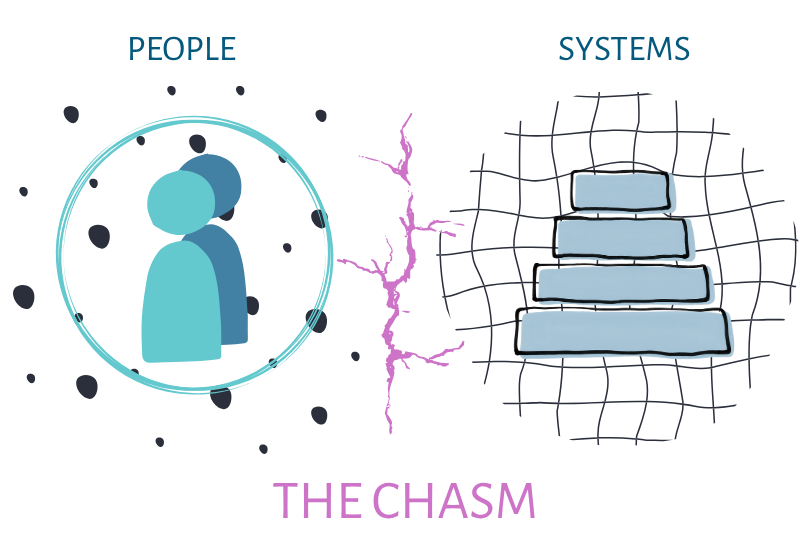
Stress moves between your people and your systems constantly. Systems generate it, people respond to it, and those responses reshape the systems in turn. Burnout, disengagement and turnover are usually what that interaction produces. Where people and the systems they work inside fall out of sync, you get a pressure point.
That’s why this diagnostic treats your organization as an ecosystem: a set of interdependencies where human experience and system conditions keep shaping each other. Intervene in one without understanding the other, and the pattern comes back. Different year. Same themes.
Where most diagnostics stop
Most diagnostic tools were built to measure one dimension at a time: either how individuals are experiencing work, or how the organization is structured. Useful data. Incomplete picture.
When you separate those two dimensions, you lose the thing that matters most: the interaction between them. That’s where pressure points form, and it’s the place most interventions skip.
Strain tells you where to intervene. Resilience tells you what to intervene with.
Where most diagnostics stop is exactly where this one starts. Reading strain and resilience together shows you where something needs to change, and what’s already working well enough to build from.
One Starting Point. Three Ways It Can Go From There.
Most relationships start in the same place, then go wherever the findings point.
Leadership Snapshot
“I know something is off. I don’t yet have the data or the language to make the case.”
A focused diagnostic with your leadership team that pinpoints where stress is concentrated, and gives you the evidence and language to make the case inside your organization.
What you leave withA domain-level findings summary, an executive presentation, and a working session built to move the conversation to its next decision.
Start the ConversationThe Snapshot is the starting point. What follows is shaped by what it finds.
Training Series
“I know where the capability gap is. What I don’t have is training built around it.”
Generic training gets layered on top of a problem, whatever’s on the calendar this quarter. This runs the other direction: three to four sessions developed directly from your diagnostic findings, so the material goes straight at the gap your people have been working around.
What you leave withA cohort trained against your own findings, working from language and material they’ll keep using after the sessions end.
The Retention Redesign
“Our onboarding, recognition, and engagement programs were built to solve something. The question is whether it’s still the right something.”
Most retention programs get built once and defended forever, even after the reasons people leave have moved. This engagement reads your current programs against what the diagnostic found, and redesigns what’s solving the wrong thing or only catching part of it. We architect the redesign. Your team builds and runs it.
What you leave withA redesigned program built on this year’s findings, and the internal capability to run it without us.
The Recalibration Retainer
“The diagnostic told me where to look. The question is whether anyone’s still looking six months from now.”
Findings age. Priorities shift, people turn over, the next initiative launches before the last one’s fully settled. This keeps your diagnostic baseline active: a standing monthly session, priority access in between, and a recurring read on how what you’ve built measures up against where you started.
What you leave withA continuous read on your organization instead of a report that goes stale the day it’s delivered.
Already know you need this across your whole organization? The same diagnostic scales to department or company‑wide. Let’s talk about scope.
Diagnostic engagements
from $14k
Training and workshops
from $4k
Each starts here and scales with scope. You’ll see the full scope and the number behind it before anything moves forward.
Not sure where you’d start? That’s what the first conversation is for.
Start the ConversationNeed to bring this conversation to leadership first?
The patterns you’re seeing have a business case behind them. This resource gives you the language to make it.
Download: What’s Actually Breaking Beneath Your Engagement ScoresOther Ways to Start
The Hidden Weight Quiz
A quick diagnostic for HR and People leaders. It shows which organizational stress patterns your role has been absorbing, and what they reveal cuts both ways: where your organization’s design needs attention, and where you’ve shaped and been shaped by its expectations.
Take the QuizLearning Together
Want a lighter first step? We also work directly with your leadership teams and HR to build shared language and capability, in a single session or a series.
Explore Speaking & TrainingReady to See the Full Picture?
This starts with a conversation about what you’re navigating, where the strain seems to start, and whether this approach fits your context.
You’ll leave with a starting point. Regardless of what comes next.