
Temporary Relief and
Lasting Change Require
Different Approaches.

There’s a kind of stress that keeps reassembling itself no matter what you try. The strategies help for a while, and then something familiar reappears in a slightly different form.
That pattern has a source. Usually more than one. And you can only work on a source you can see.
That’s what the 7C Stress-Resilience Model is built to do.
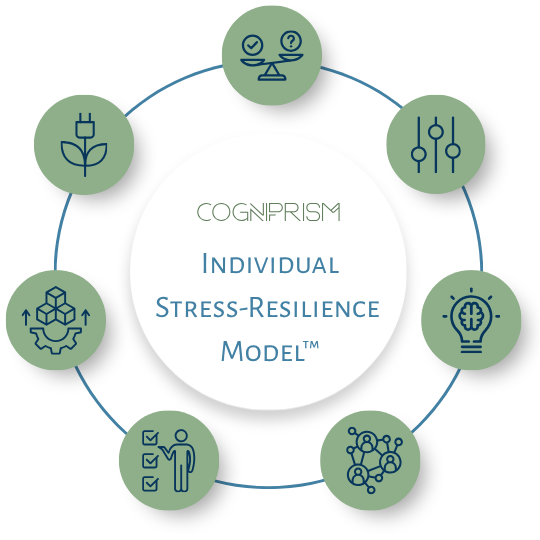
A diagnostic lens for your lived experience.
Most frameworks treat stress as one thing. One problem, one solution, one dimension to work on.
The 7C Model starts from a different premise: stress is layered. It concentrates across multiple dimensions of your life simultaneously, and those dimensions interact. Which means the pattern you’re experiencing is specific to you: your biology, your context, your relationships, what you’re inside of at work and outside of it.
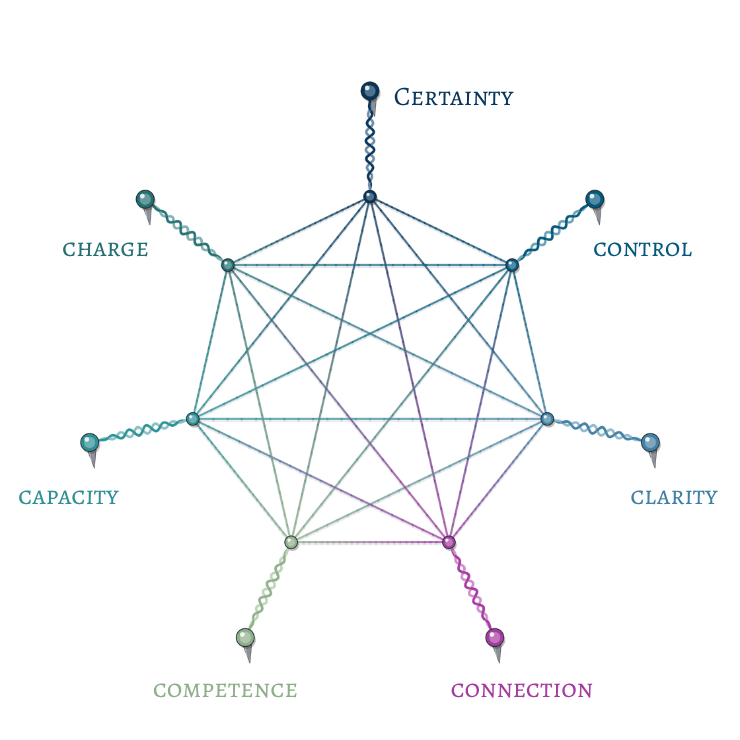
The model maps where strain is concentrated across seven domains. With that map, your effort goes where the strain is.
Where stress tends to concentrate.
Click each stress-resilience domain. Notice which ones create recognition.
When too much is in flux at once: job, relationships, health, finances, the world outside your window. Certainty strain is about needing enough stability in enough areas to function without hypervigilance.
You’re accountable for outcomes you can’t influence. Or the decisions that affect you most are made without your input. Control strain is the gap between what you’re responsible for and what you have the power to change.
The work is piling up, but you’re not sure what to prioritize. Or the expectations keep shifting, so the target moves while you’re still aiming. When Clarity is strained, the effort goes in but the orientation doesn’t come back.
You’re surrounded by people and still feel like you’re navigating this alone. Or the relationships that should restore you are costing you instead. Connection strain doesn’t always announce itself.
You’ve done this before. You know you’re capable. And yet: the doubt is louder than the evidence. Competence strain is often a gap between what you know you can do and what you trust yourself to do under pressure.
You finished the day. You did the things. And you still feel like you never caught up. When Capacity is strained, demand is outpacing what you have to give, with no real recovery built in.
You’re tired in a way that sleep doesn’t fix. Or you’re running on adrenaline and crashing unpredictably. Charge is where your body registers the strain before your mind names it.
It’s rarely just one domain.
Here’s what makes this model useful beyond a checklist: the domains interact.
Low Charge compounds Capacity. Strained Certainty makes everything else harder to navigate. Strong Connection can buffer a period of low Control. High Competence can carry you through Clarity gaps, until it can’t.
Your specific pattern across all seven domains (which are strained, which are intact, which are compounding each other) is your constellation. And it rarely matches anyone else’s.
That’s also why generic advice helps some people and misses others. A strategy that works for someone whose primary strain is Clarity won’t do much for someone whose primary strain is Charge. The intervention has to match the pattern.
The question worth asking: which of these domains feels most strained for you right now?
Two ways to work with the pattern.
The InnerWork Journal
A structured daily framework for identifying stressors across three dimensions, with assessments at the start and end so you can see what’s shifted and what’s still asking for attention. Built on a simple premise: you’re more likely to find the source when you track the pattern day by day.
1:1 Coaching
Grounded in the 7C framework. Six or ten weeks depending on what you’re working with. The goal: clarity on what’s driving the pattern, and the capacity to move through it differently.
Not sure if coaching is the right fit? The first conversation will tell us both.
Where This Connects
If your strain clusters in Control, Clarity or Certainty, look at how your work is designed: who makes the decisions, how change gets rolled out, what you’re expected to absorb without anyone naming it. And the way you and the people around you adapt to that design keeps shaping it in turn.
If you lead people, or want to bring this to someone who does:
→ Explore where organizational stress and individual experience meet